The Common App essay and every supplement
Write your college essays in your own voice
Writing a college essay is hard and stressful. AdmitUs gives you one place to do it, with your advisor (the college counselor helping you apply), your parents and the friends you invite all working on the same draft. An AI coach answers your questions about the draft and helps you write the essay yourself, in your own words.
AdmitUs also works without a private counselor or advisor. The coach and the essay reviews still help, and the student can invite a parent or a friend to read along.
Sign-in asks Google only for your name, email and profile picture. If you started your essay in Google Docs, you can bring that draft in. AdmitUs is invite-only for now.

Inside the workshop
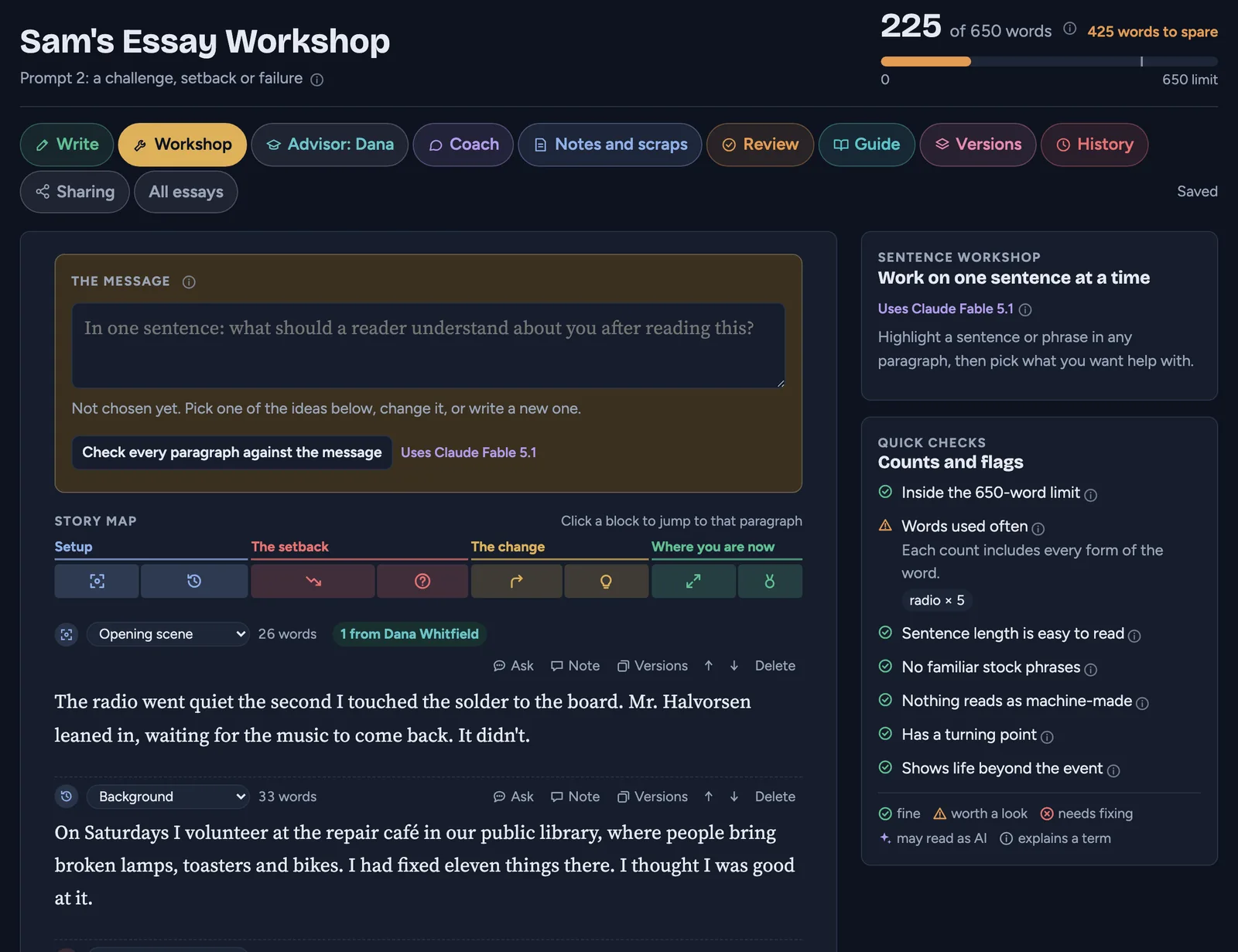
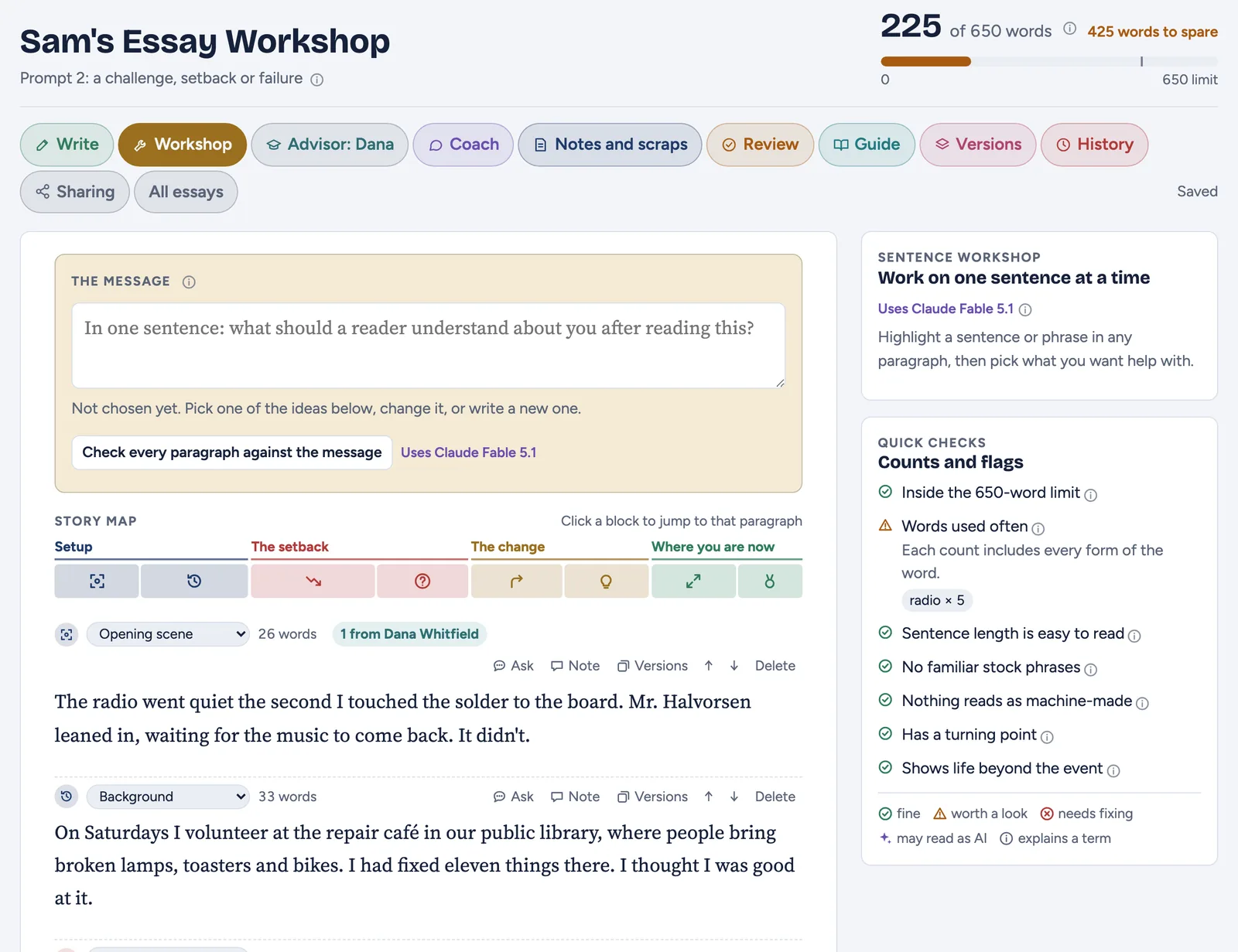
This is the Workshop tab, where the student revises the draft. Each paragraph with advisor guidance carries a marker, and on the right the sentence workshop lets the coach help with one sentence at a time.
Your advisor's guidance
A counselor's advice usually arrives in pieces: a comment in a Google Doc, an email, a note from a meeting. In AdmitUs each piece becomes one item, aimed at the part of the essay it's about, such as the opening or the ending. The student then marks every item one of three ways:
- Following
- The coach checks the draft against it.
- Not following
- The coach respects the student's choice and doesn't bring it up again, except once in a full review.
- Not decided yet
- The coach shows what following it would look like.
The coach reads every item, with the student's decision, before it answers, so every answer takes the advice into account.
The example essay: a student fails to fix an old radio for Mr. Halvorsen at a library repair café.
Start with the radio, not the café
Say what you learned once
End back at the workbench
Student's note: I'd rather end with Mr. Halvorsen turning the dial.
The AI coach
You're likely to use AI on your essay, so AdmitUs gives you an AI that coaches you instead of writing for you. The coach asks you questions, points at your own sentences and suggests what to try next. Its instructions tell it to help you write the essay yourself and never to write the whole essay, because the Common App asks every applicant to certify that what they submit “is my own work, factually true, and honestly presented.”
When the coach does suggest wording, your draft stays as it was unless you put the words in yourself. Beside the draft, an AI writing check points out any sentence you pasted word for word from a suggestion until you rewrite it, along with stock phrases like “little did I know” and words that often read as AI-written, like “delve” and “tapestry”. It is not an AI detector and decides nothing. Every coach answer is kept with the question you asked.
The radio went quiet the second I touched the solder to the board. Mr. Halvorsen leaned in, waiting for the music to come back. It didn't.
Advisor guidanceStart with the radio, not the café
Open on the moment the radio goes quiet in your hands. The reader can learn what a repair café is later.
Your advisor asked you to start with the radio, and you do. What did you notice in the second after the music stopped?
Reviews and the sentence workshop
Once the student has decided on each piece of guidance, a review checks the draft against it and against eight criteria. It scores the same eight things every time and says, item by item, whether the draft follows the advisor's guidance.
To work on a single sentence, the student highlights it in any paragraph, and the coach helps with just that sentence.
The eight review criteria
- Answers the promptThe reader can name the essay's main point in one sentence.
- Shows the change happeningThe change is shown in a specific scene, not only described.
- Reflection and insightThe lesson is the writer's own and goes past a familiar line.
- Sounds like the writerIt reads like a thoughtful senior talking to an interested adult.
- Specific detailNames, places and details only the writer could know.
- Structure and pacingThe opening makes the reader want to keep going, and the ending comes back to it.
- Beyond the eventThe reader learns who the writer is outside this one event.
- Clean writingAt or under the word limit, with correct grammar and punctuation.
Sharing, history and privacy
Everyone's notes and edits sit in one place with the draft, stamped with who made them and when. That includes friends the student invites, who can add notes from the start and can edit and use the AI tools once the student turns that on.
The essay belongs to the student. Apart from our team, who run the service, only the people the student invites can open it. The student sets what each one may do: see the draft, see notes, scraps and guidance, see reviews, see conversations with the coach, add notes, or edit.
A parent can follow the draft and leave notes without reading the student's private conversations with the coach.
- See the draft: allowed
- See notes, scraps and guidance: not allowed
- See reviews: not allowed
- See coach conversations: not allowed
- Add notes: allowed
- Edit the draft and use the AI tools: not allowed
Your data and saved versions
To answer a question, the coach sends the draft, notes, the newest review, the guidance and the conversation to Anthropic, the company that makes the Claude AI models. Your work is stored on our server in Amazon Web Services, with backup copies in two US regions. We don't use your writing to train AI models.
Every save is kept as a new version, and those versions can't be changed or deleted from inside the app, so earlier wording stays available. On the Versions tab the student can also name a draft and go back to it later, and the History tab lists every change, with a button to put the old text back. Putting old text back saves it as a new version. The privacy policy has the details.
More about AdmitUs
Invite-only for now
For now, we set up each student's essay ourselves. If you've been invited, sign in with the Google account for the email that was added.
An email address for invitation requests will be added here before launch.